Spotted damp and mould?
If you notice any signs of damp or mould, please get in touch with our Customer Service team as soon as you can.
Contact usDamp, mould and condensation can have a serious impact on your home and health.
That’s why we take a proactive approach to managing and preventing these issues through a mix of reactive repairs, planned work and advice on how to manage and prevent problems.
Our goal is to ensure that no-one has to endure the negative effects of damp and mould in their home. We are dedicated to resolving any issues as quickly and effectively as possible.
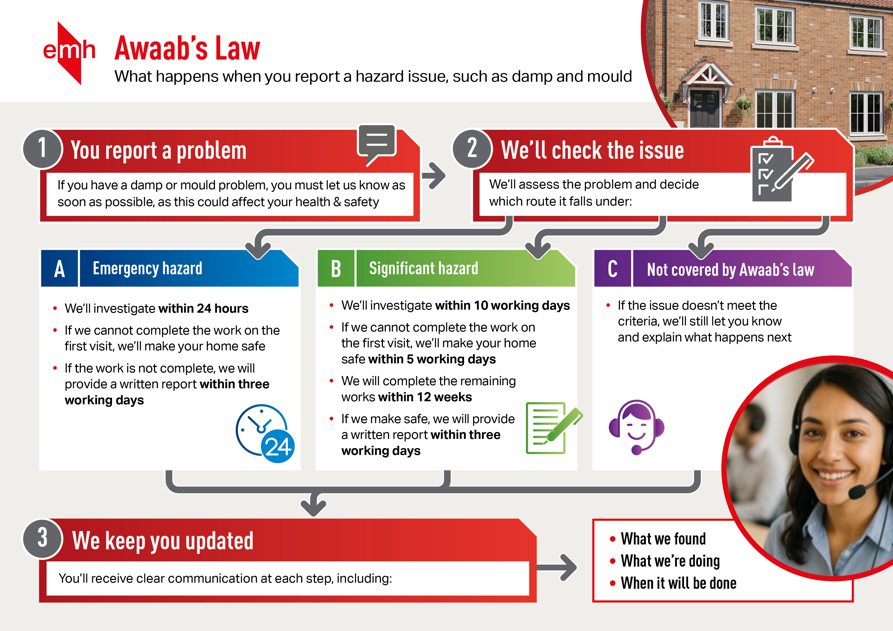
In response to the Housing Ombudsman Service’s research on damp and mould, and the introduction of Awaab's Law, we’ve established a rapid response team to investigate all reports within 10 working days.
We’re fully committed to meeting the legal timeframes for investigating and repairing reported housing hazards such as damp and mould under Awaab’s Law (introduced October 2025).
Read the section below for more on this and what it means for you and your home.
Damp is a build-up of moisture in your home.
It affects building elements such as walls, floors and ceilings, as well as home furnishings and belongings - such as carpets, curtains, wallpaper, furniture and clothes.
If damp is present in a building, it can also lead to the growth of mould and other microorganisms.
Moisture can be caused by property condition, leaks or many other factors. One of the main causes is condensation.
If you are a resident, please report damp and mould to us:
Online: MyHomeOnline
Email: customerservices@emh.co.uk
Call: 0300 123 6000
WhatsApp: Chat with us here and share photos and videos of any issues you may be facing.
Awaab’s Law: What it means for you
In October 2025, new legal duties came into force under Awaab’s Law, named in memory of Awaab Ishak. These rules apply to all social landlords and are designed to ensure that damp and mould hazards are dealt with quickly and effectively.
If you report damp or mould in your home, we must:
- Investigate within 10 working days of being made aware
- Provide a written summary of findings within three working days of inspection
- Begin repairs within five working days if there is a health risk
- Complete emergency repairs within 24 hours
- Offer alternative accommodation if there is an imminent risk of harm and the home can’t be made safe in time.
These timeframes are now part of your tenancy agreement and are legally enforceable.
What we’re doing
We take reports of damp and mould seriously. Our team will:
- Respond quickly to reports and investigate the cause
- Carry out repairs and follow up to make sure the issue is resolved
- Invest in long-term solutions like better insulation and ventilation.
For more information and advice including how to spot and stop the causes of damp and mould – take a look at our leaflets below.
Condensation happens when warm, moist air meets a cold surface and turns into water droplets.
You’ll often see it on windows, mirrors, and even walls — especially during colder weather.
Everyday activities that release moisture include:
- Cooking
- Washing, bathing and showering
- Drying clothes indoors
- Breathing - we all produce moisture.
Without good airflow, this moisture can build up and cause condensation.
While a little condensation is normal, too much can lead to problems in your home, like:
- Damp patches
- Mould growth
- Musty smells
- Damage to paint, plaster and wallpaper.
It’s important to manage condensation to protect your home and health.
Ventilate your home:
- Open windows for short periods, especially in kitchens and bathrooms
- Use extractor fans if fitted
- Keep trickle vents open (if you have them)
- Don’t block air bricks or vents — they help your home breath.
Keep your home warm:
- Try to maintain a steady temperature between 18–21°C
- Use low-level heating rather than letting rooms get cold and then reheating.
Reduce moisture:
- Cover pans when cooking and use lids
- Dry clothes outside when possible, or use a vented tumble dryer
- If drying indoors, open a window and close the door to contain moisture
- Wipe down condensation from windows and walls daily.
Check for early signs:
- Look behind furniture and in corners for mould
- Leave space between furniture and external walls to improve airflow
- Clean mould with an HSE-approved product — never dry-brush it.
This could be through:
- Badly fitting or broken windows or doors
- Broken or loose roof tiles or slates
- Leaking pipes
- Broken/leaking/blocked gutters or rainwater pipes
- Rotten fascia boards, soffits, or barge boards
- Breached damp proof courses
- Damaged render, pointing, brickwork or chimney breasts.
If your home has any of these issues – please let us know as soon as possible.
How we'll respond