
Spotted damp and mould?
If something in your home could harm you or your family, from damp and mould to a broken boiler or a loose handrail, tell us as soon as you can.
Report itAwaab's Law sets out how quickly we must investigate and fix serious problems in your home.
It's named after Awaab Ishak, who died aged two because of mould in his family's home. Since October 2025, the law has covered damp and mould, as well as any hazards that are considered an emergency.
These timescales form part of your tenancy agreement and are legally enforceable. We’re committed to meeting them and will act sooner where your household needs us to.
Read the sections below to find out what’s covered, how to report a problem, and what you can expect from us.
Awaab's Law covers serious hazards caused by a problem with your home or building
A hazard is something that could harm the health or safety of someone in your household. We'll take into account who lives with you when we decide how quickly to act.
- Damp and mould: Mould on walls or ceilings, leaks, water coming in
- Excess cold: Broken boiler, no heating, broken windows or doors letting cold in
- Excess heat: Heating stuck on, rooms that overheat, windows that won't open
- Falls: Loose stair handrails, broken balcony railings, broken steps or paths
- Structural collapse: Sagging or cracked ceilings, loose roof tiles, unsafe walls
- Fire and explosions: Missing or broken smoke alarm, a smell of gas
- Electrical: Exposed wires, sockets that spark, scorch or smell
- Hygiene, pests and food safety: Pests entering through gaps, no working toilet, kitchen not safe for preparing food.
Anything dangerous that needs fixing the same day is covered, whatever the cause.
If you smell gas, call the National Gas Emergency Service on 0800 111 999 straight away.
Fire safety in shared areas of flats, such as fire doors and escape routes, is managed separately under fire safety law. Please still report it to us.
If you are a resident, please report damp and mould to us
Online: MyHomeOnline
Email: customerservices@emh.co.uk
Call: 0300 123 6000
Out of hours' emergencies: 0300 123 6000
WhatsApp: Chat with us here and share photos and videos of the problem.
Someone else can report a problem for you, such as a family member, support worker or neighbour. You can also tell one of our operatives or your Communities Officer when they visit.
Tell us about your household. Let us know if anyone living with you is a child or older person, has a health condition or disability, or needs information in another language or format. You don’t need to provide medical evidence. This helps us decide how quickly we need to act.
Want us to visit? If you’d prefer us to visit your home rather than assess the problem from photos, just let us know. It’s best to tell us when you first report the problem.
Awaab’s Law: What it means for you
When you report a problem that could be a serious hazard, we must:
- Check and make your home safe within 24 hours if it could be an emergency.
- Investigate within 10 working days for other serious hazards.
- Give you a written summary within 3 working days of our investigation, explaining what we found, what we’ll do and when. You’ll receive this even if we find no action is needed, and we’ll explain why.
- Finish the work needed to make your home safe within 5 working days of our investigation.
- Start work to stop the problem coming back within 5 working days, or as soon as we can and no later than 12 weeks.
- Keep you updated on progress, tell you if an appointment changes and give you advice on staying safe while you wait.
If we’ve assessed the problem from photos and you want us to visit, you can ask for an in-person inspection. We’ll carry this out within 10 working days.
If you need equipment, such as a dehumidifier or heaters, to keep your home safe while we fix the cause, we’ll provide it.
These timescales form part of your tenancy agreement and are legally enforceable.
If we can't make your home safe in time, we'll offer you somewhere else to stay
This applies to emergencies and to other serious hazards where the safety work can't be finished within the timescales above.
- We'll pay for it
- We'll take reasonable steps to make sure it suits your household's needs
- You can choose whether to accept it or not.
You can stay there until the safety work in your home is finished.
Awaab’s Law applies if you rent your home from us under a tenancy
This includes supported and temporary homes where you have a tenancy.
It does not apply to Shared Owners, leaseholders or people whose homes are let under a licence.
We’ll still deal with any safety problems you report to us. Shared Owners can find more information on our Repairs for Shared Owners page.
You can make a complaint
If you don't agree with what we found, or how we've handled your report, you can make a complaint
If you're still not satisfied after our complaints process, you can contact the Housing Ombudsman Service
The government's Make Things Right website explains your rights under Awaab's Law.
Damp is a build-up of moisture in your home
It can affect walls, floors and ceilings, as well as your belongings, including carpets, curtains, wallpaper, furniture and clothes.
Damp can lead to mould and can be caused by leaks, problems with the building, condensation or other issues.
Cooking, showering and drying clothes are part of normal life. They will never stop us dealing with damp and mould. If you see more than a small spot of mould, or it keeps coming back, report it to us and we’ll treat it.
Condensation happens when warm, moist air meets a cold surface and turns into water droplets
You'll often see it on windows, mirrors and walls, especially in colder weather. Everyday activities that release moisture include:
- Cooking
- Washing, bathing and showering
- Drying clothes indoors
- Breathing.
A little condensation is normal. If you have a lot, or it's leading to damp patches, mould or a musty smell, report it to us.
These tips can help day-to-day. They don't replace reporting a problem to us
Ventilate your home:
- Open windows for short periods, especially in kitchens and bathrooms
- Use extractor fans if fitted, and tell us if they don't work
- Keep trickle vents open if you have them
- Don't block air bricks or vents
Keep your home warm:
- Try to keep a steady temperature between 18 and 21°C
- Low, steady heating works better than letting rooms get cold and reheating them
Reduce moisture:
- Put lids on pans when cooking
- Dry clothes outside when you can. If drying indoors, open a window and close the door
Check for early signs:
- Look behind furniture and in corners
- Leave a gap between furniture and outside walls
If you're worried about the cost of heating your home, our Money Matters team can help.
This could be through:
- Badly fitting or broken windows or doors
- Broken or loose roof tiles or slate
- Leaking pipes
- Broken, leaking or blocked gutters or rainwater pipes
- Rotten fascia boards, soffits or barge boards
- A damaged damp-proof course
- Damaged render, pointing, brickwork or chimney breasts.
If your home has any of these problems, let us know as soon as possible.
For information on keeping your boiler in good working order, visit our boiler maintenance page.
A broken boiler or no heating can be an emergency, especially in cold weather or if someone in your home is vulnerable. Report it straight away.
How we'll respond
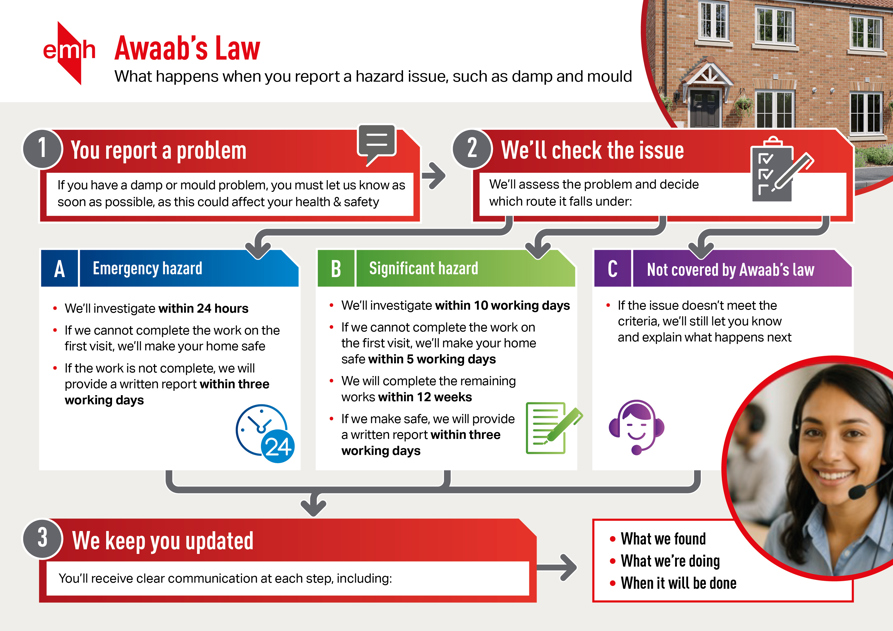
Text version of the above flowchart
| What happens | When |
| We check possible emergency and make your home safe | Within 24 hours |
| We investigate other serious hazards | Within 10 working days |
| We tell you in writing what we found and what we'll do | Within 3 working days of the investigation |
| We finish the work to make your home safe | Within 5 working days of the investigation |
| We start work to stop the problem coming back | Within 5 working days, and no later than 12 weeks |
| We visit if you ask for an in-person inspection | Within 10 working days of asking |
| We offer you somewhere else to stay if we can't make your home safe in time | When a timescale can't be met |